The Right Language-Learning Advice Can Still Be Wrong for You
“Stop studying. Just watch Japanese television.”
This is lovely advice.
If you already understand Japanese.
If you don’t, your evening may look more like this:
You press play. Someone shouts. A door slams. The subtitles race past. Forty minutes later, you’ve learned that Japanese people speak Japanese extremely well.
Perhaps you catch one familiar word.
A small victory—although you’re no longer certain who said it, what happened afterward, or why everyone is suddenly crying.
So you try again tomorrow.
And when it still feels like noise, an uncomfortable thought begins creeping in:
Maybe I’m simply bad at this.
You probably aren’t.
The advice may be perfectly good. You may simply be standing on the wrong rung.
Good advice has an invisible starting point
Advanced learners often recommend what helps them now:
Watch native television.
Listen to podcasts.
Read novels without looking everything up.
Stop studying grammar.
Learn through conversation.
Immerse yourself for several hours every day.
None of this is necessarily wrong.
The problem is that we can see what advanced learners are doing today. We can’t always see the years of vocabulary, grammar, sound recognition, and cultural knowledge underneath it.
That invisible foundation changes what the activity can do.
An advanced learner can hear one unfamiliar expression in a podcast and use everything around it to make sense of it.
A beginner may hear an entire podcast and find that nearly everything is unfamiliar—including the sounds separating one word from the next.
They’re performing the same activity.
They are not having the same learning experience.
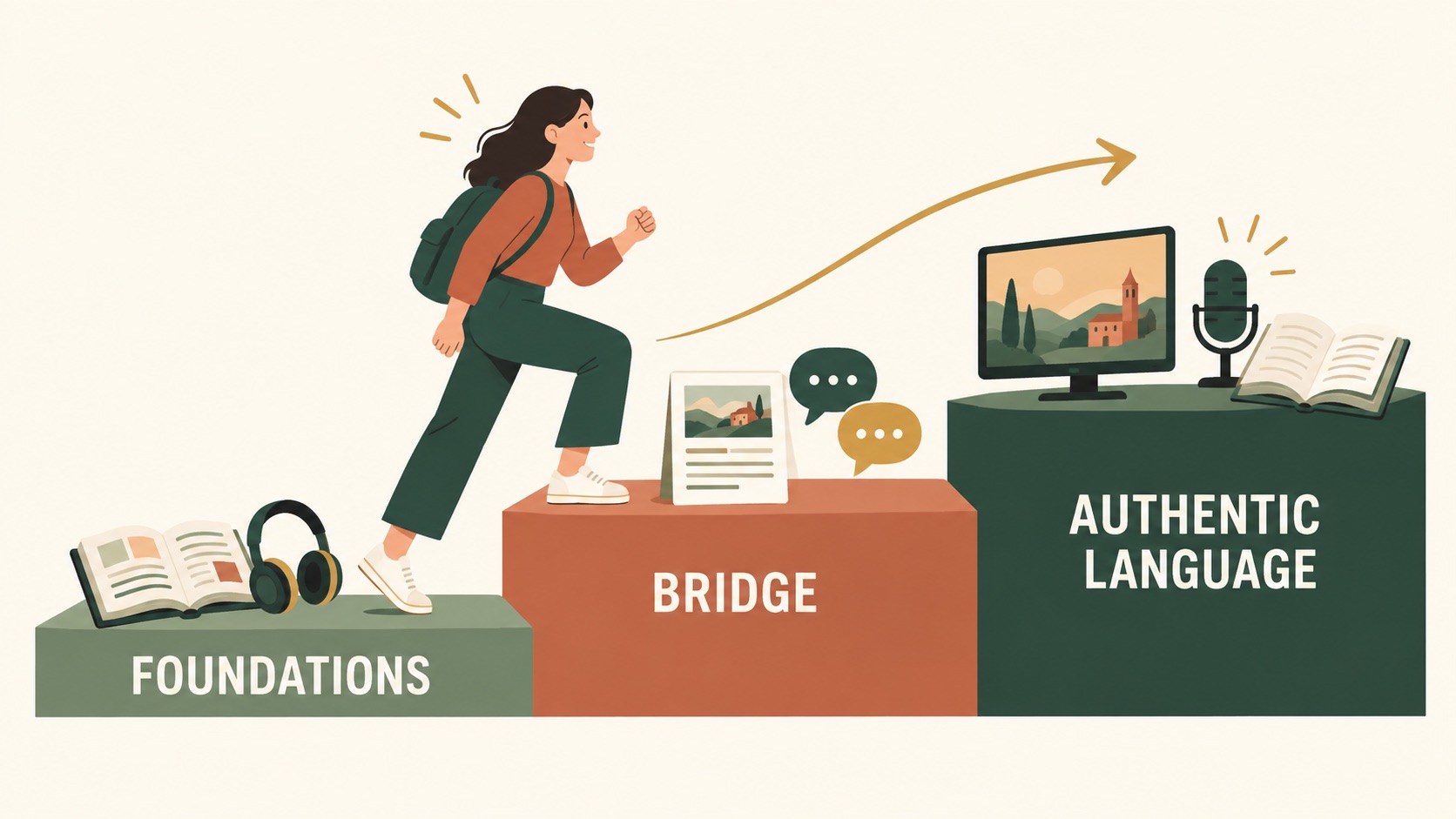
Welcome to the Fluency Ladder
I think of every language you know as standing on its own ladder.
Your English might be near the top. Your French may be halfway up. Your Japanese might still be gripping the first rung with both hands and asking who thought three writing systems were necessary.
That says nothing about your intelligence.
It only describes what that particular language can currently do without assistance.
At the bottom of the ladder, a language needs structure, repetition, short explanations, manageable amounts of new material, and plenty of examples.
Further up, it needs large amounts of understandable input—material that is mostly familiar but still introduces something new.
Near the top, authentic content becomes far more powerful. You can follow ideas, notice patterns, infer meaning, and continue learning while doing something you genuinely enjoy.
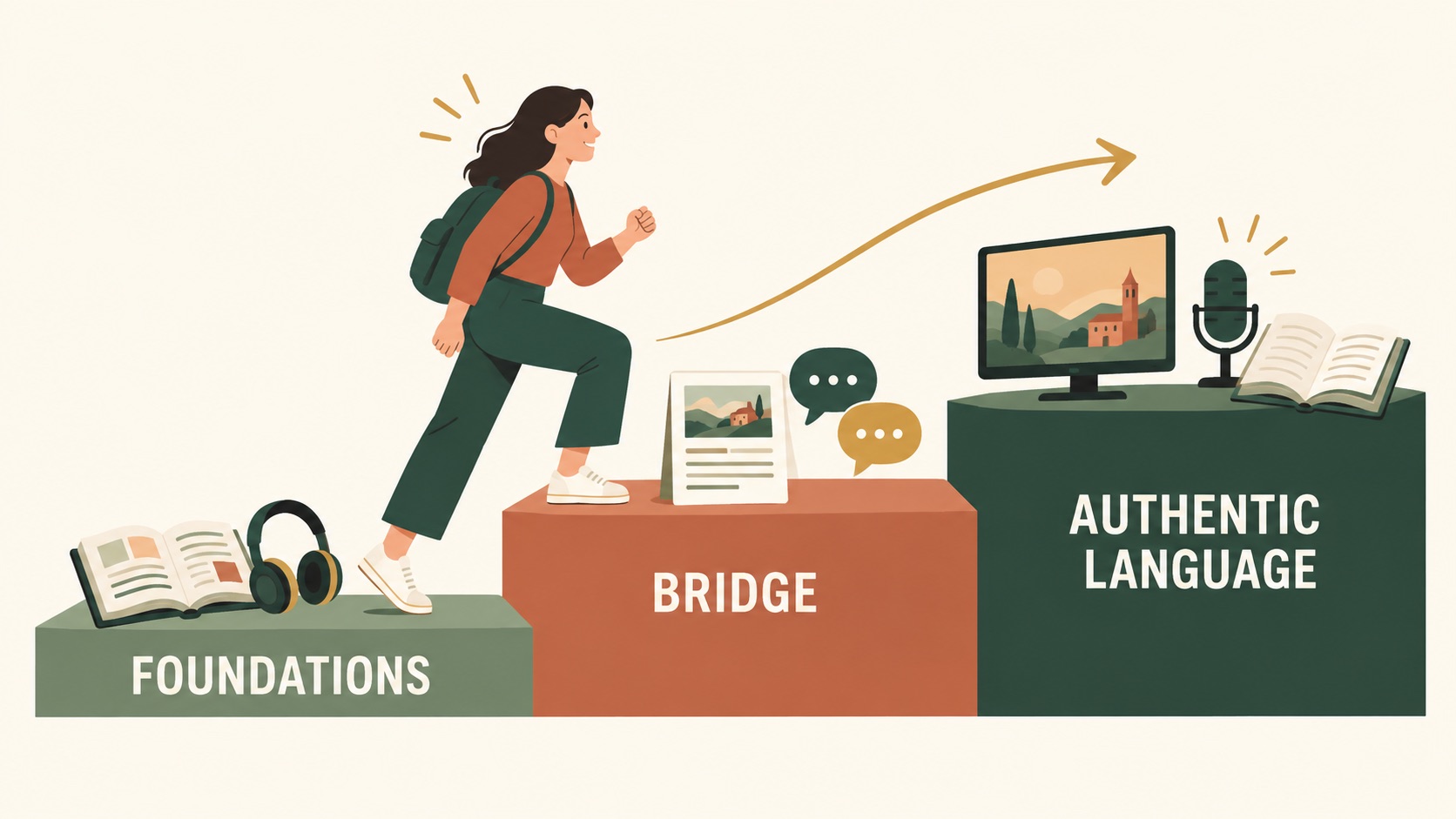
The Fluency Ladder: foundations, a supported bridge, then authentic language.
Authentic content is the destination.
It just isn’t always the best helicopter ride to the summit.
The Everest problem
Imagine being flown directly to the top of Mount Everest.
Technically, you’ve reached the summit.
Unfortunately, your body hasn’t had time to adjust to the altitude, so this achievement may be shorter and less celebratory than expected.
Beginning learners often do something similar with native content.
They place themselves at the highest level because that is where “real language” lives. But they haven’t yet developed the vocabulary, pattern recognition, or processing speed required to function there.
When the experience goes badly, they blame their motivation.
Or their memory.
Or their age.
Rarely does anyone say, “Perhaps I was dropped several thousand metres above my current altitude.”
But that may be the more useful explanation.
How to find your current rung
The right material should not feel effortless.
It should also not require a small emergency response team every three sentences.
Try asking:
Can I follow the general meaning without constant rescue?
Is most of the language already familiar?
Do unfamiliar words appear inside enough context to be useful?
Am I noticing recurring patterns?
Can I remain interested in the message itself?
After finishing, can I remember or reuse anything I encountered?
If the answer is consistently no, you may not need more discipline.
You may need a better bridge.
That bridge could be a graded reader, a short learner-friendly podcast, a tutor-supported conversation, or an AI-generated lesson built around familiar vocabulary and a subject you actually care about.
The format matters less than the fit.
Easier material isn’t going backwards
This is where ambitious learners sometimes resist.
Moving to easier material feels like admitting defeat.
But material you can meaningfully process often teaches you more than difficult material you merely survive.
When you understand most of what you hear or read, familiar language starts returning in new situations.
A phrase appears in one story, then another conversation, then a video.
Eventually your reaction changes from:
What on earth is that?
to:
Oh, you again.
Those repeated meetings are what make language feel familiar and retrievable. Constantly jumping to harder material can interrupt that process just as it begins.
The goal isn’t to remain comfortable forever.
It’s to choose difficulty that produces growth instead of permanent panic.
Don’t copy the activity. Diagnose the rung.
The next time someone says a particular method is “the best” way to learn a language, look for the invisible sentence at the end:
…for someone at my current level, with my existing knowledge, goals, time, and interests.
Their advice may still be worth trying.
But if it leaves you surrounded by meaningless noise, don’t immediately turn that experience into a judgment about your ability.
Change the material.
Add support.
Move down one rung.
Build the bridge you’re missing—and then climb.
Because the best learning method isn’t the one that sounds most advanced.
It’s the one that helps your language become advanced enough to need it less.
Choose one resource you’ve been struggling through and replace it this week with something you can mostly understand. Notice whether learning suddenly feels lighter—and whether more of the language stays with you.
A small note
I’m building Speak Your Mind for people who want to practise the things they actually want to say in Thai or Japanese—at a level they can use. If that sounds like you, you’re welcome to take a look.
