How to Practice Speaking a Language Alone
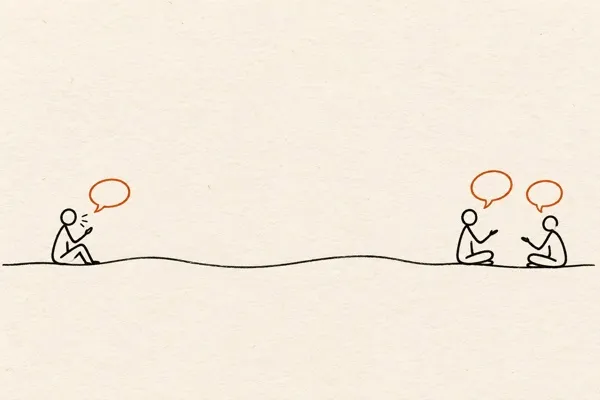
Talking to yourself in Japanese is useful for about forty seconds.
Then you realize your conversation partner is being suspiciously cooperative.
They never interrupt. They never ask, “Wait—what do you mean?” They never reply with a word you didn’t prepare for. They definitely never change the subject while you’re still locating the verb.
You haven’t had a conversation. You’ve held a tiny press conference with no reporters.
And yet, being told to “just speak from day one” can feel like the opposite kind of absurd. Someone is waiting. Your mind goes blank. Every sentence you practiced on the way there has politely left the building.
If you want to know how to practice speaking a language alone, you don’t have to choose between those two experiences: talking into the void forever or making yourself miserable in a conversation you’re not ready for.
There is an in-between place. And, used well, AI can be surprisingly good at it.
The Part Nobody Mentions A
What we’ll cover
AI Is Not the Finish Line. It Is the Useful Bit in the Middle.
Preparation Is Not Cheating. It Is How Adults Handle Things.
Try This This Weekbout Practicing Alone
Private practice is not fake practice. It is where you notice which words you can recognize but can’t retrieve, where your pronunciation goes wobbly, and where a sentence that looked perfectly innocent on a screen suddenly refuses to come out of your mouth.
That is useful information. Frankly, it is better to discover that 〜そうな気がする has turned into a mouthful while you are alone than while you are trying to sound thoughtful over dinner.
But solo practice has a ceiling. The mirror is generous. It never says, “Why?” It never misunderstands you. It never comes back with an answer that is faster, stranger, or more interesting than the one you rehearsed.
Real speaking lives in that messy bit after your first sentence.
AI Is Not the Finish Line. It Is the Useful Bit in the Middle.
An AI conversation or AI tutor is useful for the learner who is not quite ready to launch into regular conversations with people, but has also had enough of listening to their own voice in the kitchen.
Give it something real. Not “My name is…” unless that is genuinely the most pressing fact about your life today.
Try one of these instead:
you want to tell a friend why you are tired this week;
you have an opinion about a film you watched;
you need to explain a small work problem;
you want to ask whether a restaurant will be busy; or
you are mildly annoyed about something and would quite like to say so without accidentally starting a diplomatic incident.
First, prepare the thought. Notice how native speakers package a similar idea. Borrow a useful chunk. In Japanese, for example, 〜そうな気がする (-sō na ki ga suru) lets you say “I have a feeling that…” without presenting your opinion as a grand announcement from the mountaintop.
Then ask the AI to do something with your thought. Ask one follow-up question. Misunderstand one small detail. Change the situation from casual to polite. Reply a little faster. Make you explain the missing word instead of rescuing you immediately.
Now you are no longer reciting. You are responding.
That is the middle ground worth having: enough interaction to make your language move, without the full social pressure of trying to charm a stranger while your brain is still loading.
Make the AI Slightly Annoying on Purpose
The best AI practice session is not the one where the AI congratulates you for every sentence and tells you that you are doing wonderfully. Charming? Yes. Particularly useful? Not always.
Ask it to be helpful in a way that creates a little resistance.
You might say:
“I’m practicing Japanese for a casual conversation. Reply naturally, ask one follow-up question at a time, and don’t correct me until I ask.”
Or:
“Pretend you didn’t catch one important detail. Let me try saying it another way before you help.”
Or, when you are feeling brave:
“Challenge my opinion politely. Keep the language natural but manageable.”
You do not need an hour-long roleplay in which you pretend to negotiate a merger, buy a train ticket, and meet someone’s grandmother. One thought. One response. One repair. That is plenty.
The point is to rehearse the part after the sentence: clarifying, adding a reason, softening an opinion, asking for time, or finding another route when the first route is closed.
Start With Something You Actually Want to Say
This is exactly why I built Speak Your Mind: it is a Japanese and Thai speaking-practice app that starts with a thought from your real life, rather than a sentence somebody picked for Chapter 4.
You start with a thought you actually want to express in English. Choose Japanese or Thai, and it gives you natural ways to say it, useful chunks worth stealing, and an explanation of how the language is arranging your meaning.
Then take that material somewhere useful. Say it aloud. Change one detail. Let an AI tutor ask about it. Make the situation more formal. Prepare a likely follow-up. See which bit makes you hesitate.
Speak Your Mind is not meant to hand you a shiny little script and call it fluency. It is meant to give you language with enough life in it that you can use it, bend it, and keep going when somebody answers back.
And Then, Yes, You Need People
AI can give you turns. It can give you repetition. It can even surprise you a little.
What it cannot give you is the feeling of having a real person in front of you: the timing, the warmth, the awkward pause, the look on their face when you have accidentally said something much stronger than you meant to.
Eventually, take one prepared thought to a patient tutor, a friend, a barista, a classmate, or any low-stakes interaction that already belongs to your life.
Tell them what you saw in a film. Ask the question you prepared. Explain the small thing that happened at work. Bring two repair phrases and the right to pause for a second. You are not there to demonstrate your “true level.” You are there to learn what happens when another human mind enters the room.
That is where your language becomes more flexible.
Preparation Is Not Cheating. It Is How Adults Handle Things.
There is a peculiar idea floating around language learning that preparation makes your speaking less authentic. As if the only honest sentence is one you dragged out of your brain while panicking in public.
No thank you.
Professional interpreters prepare. Presenters rehearse. Native speakers think through difficult conversations before they have them. Preparation does not make the eventual conversation fake. It means you cared enough about what you wanted to say to give yourself a chance of saying it.
The useful question is not, “Did you prepare?”
It is, “Can you still respond when the conversation changes?”
If you can, your preparation did its job.
Try This This Week
Pick one thought you have genuinely wanted to say in Japanese or Thai.
Find two or three chunks that make it sound like something a real person would say. Say it aloud once. Then let an AI tutor ask one question about it. If you get stuck, do not throw the whole thought away. Repair it. Simplify it. Try again.
Then, when you are ready, use some version of it with a person.
Not because you need to prove that you are brave enough to speak from day one.
Because the whole point of preparing language is getting to use it in a life that is already waiting for you.
If retrieving the right words is what keeps stopping you, read How to Remember Thai Vocabulary: Give Each Word a Job.