How to Learn Thai While Living in Thailand
I learned several of my other languages in what now feels like a suspiciously civilized order.
I studied first. I built substantial ability. Then I visited or lived in the place where people spoke the language.
By the time daily life started testing me, I had already revised for the exam.
Thai has been the opposite.
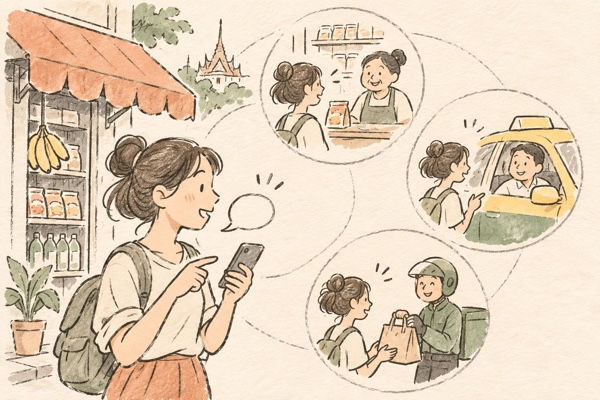
I live in Thailand while my Thai is still far from developed. The taxis, shops, deliveries, restaurants, and small everyday problems did not receive that memo. They keep producing conversations anyway.
If you are wondering how to learn Thai while living in Thailand, this is the part most general study plans miss: sometimes you do not get to build the whole language and then enter real life.
Sometimes real life arrives first.
What I’ll cover
Why learning Thai on the spot feels different
Why real life does not follow the textbook sequence
How I use Semi-Permanent Fluency Circles
How Moment-to-Moment Fluency Circles interrupt the plan
The small preparation routine I use before a real situation
Where Speak Your Mind fits without pretending I am fluent
What Thai should you learn first?
My other languages gave me a runway
When you reach a comfortable level before entering the country, you have a runway.
You can listen before every interaction becomes urgent. You can collect vocabulary before you need it. You can make mistakes in private, organize the language, and arrive with enough range to improvise when the conversation changes.
Thai has often felt more like building the runway while the plane is already moving.
I may know that I need more listening practice, a stronger vocabulary, better control of tones, and a much deeper feel for natural Thai. All true.
But the person in front of me may simply want to know where I am standing, what I ordered, which building I mean, or whether I want the driver to wait.
The long-term diagnosis and the immediate communication problem are both real. They just run on different clocks.
Real life does not follow the textbook sequence
A textbook can decide that this week is about family members and next week is about the weather.
Life is less cooperative.
You may need to explain a delivery problem before you can describe your cousins. A taxi driver may call before you have completed the transport chapter. A restaurant conversation may suddenly require a preference, a clarification, and an answer to a follow-up question you did not know was coming.
Transactional conversations look small from a distance. In real time, they can become tiny ambushes.
They also produce very different reactions.
Some people hear my imperfect Thai and keep speaking Thai. Others switch to English. Sometimes they are being helpful. Sometimes my Thai is simply not functional enough for that moment.
I cannot control which person I meet or how they interpret my ability. If I treat every English reply as a final judgment on my Thai, I make the emotional cost of speaking much higher than it needs to be.
So I try to give myself a smaller job: prepare what I am likely to need, use what I can, notice what breaks, and keep going.
My first map: Semi-Permanent Fluency Circles
This is where I use my concept of Fluency Circles.
Imagine that you stand at the center of several concentric circles. The language closest to you is the language most relevant to your life now. The farther a topic sits from the center, the less urgently you need it.
My Semi-Permanent Fluency Circles cover the situations that keep returning over time.
For someone living in Thailand, an inner circle might include:
ordering and asking about food;
transportation and locations;
receiving deliveries;
small service problems;
making appointments;
asking for clarification; and
responding when somebody asks the predictable questions about where you are from or how long you have lived here.
This is practical Thai for everyday life, but it is not one universal list.
Your circles should reflect your actual days. Someone who works in a Thai office, cares for a child, manages a household, spends every evening at a gym, or dates in Thai will need very different language near the center.
The closer a topic moves toward the center, the more specific it should become.
“Transportation Thai” is broad.
“Telling a driver which condo entrance I am standing at” is something I can prepare.
My second map: Moment-to-Moment Fluency Circles
The semi-permanent circles give me direction, but life still produces surprises.
That is where Moment-to-Moment Fluency Circles come in.
A moment-to-moment circle temporarily moves one immediate situation to the center. Tomorrow's appointment may matter more tonight than my normal study theme. A phone call may deserve ten minutes of preparation even if phone language was nowhere in this week's plan.
This is not abandoning the plan. It is allowing relevance to interrupt it.
After the situation passes, I return to my normal circles. If the same problem keeps returning, it earns a more permanent place near the center.
This distinction keeps me from making two opposite mistakes:
following a fixed curriculum so rigidly that I remain helpless in my actual life; or
chasing every surprise so randomly that I never build continuity.
The semi-permanent circles provide continuity. The moment-to-moment circles provide responsiveness.
I need both.
The small routine I use before a real situation
When a situation is close enough to become urgent, I do not try to master the entire topic.
I prepare a small package:
The real message. What do I actually need the other person to understand?
The social relationship. Am I speaking to a friend, a stranger, staff member, driver, older person, or professional?
Two likely replies. What might they ask next?
One repair phrase. How will I ask them to slow down, repeat, or let me clarify?
A simpler version. If the first sentence disappears, what is the smallest version that still solves the problem?
That last step matters.
My goal is not to perform a perfectly memorized Thai monologue and hope the other person respects the script. Preparation should make me more flexible, not more fragile.
I want somewhere to begin, a few pieces I can recognize, and somewhere safe to land when the conversation changes.
If you need a quieter runway before trying the language with somebody else, practice speaking alone without staying alone forever. Private preparation can be a bridge to interaction rather than a permanent hiding place.
Where Speak Your Mind fits
Knowing that I should prepare personally relevant language did not automatically make the right lesson appear.
That gap is one reason I built Speak Your Mind.
I can begin with the thought I genuinely need for the situation in front of me. Speak Your Mind gives me natural ways to express it, separates casual and more respectful packaging, lets me hear the language, and breaks the sentence into reusable pieces.
For Thai, I can also switch the lesson between looped and loopless script styles. That matters because the Thai I meet in apps, menus, and signs does not always resemble the style a beginner first learns.
The app does not make me fluent before the appointment, taxi call, or delivery arrives.
It does something more honest: it helps me prepare one useful piece of Thai for the life I am already living.
That preparation also helps me build a shorter route instead of forcing myself to stop translating. I am not trying to erase every trace of English overnight; I am making the language for this situation easier to retrieve.
Then the real conversation gives me information. Which part came easily? Which reply did I miss? Which word needs better pronunciation? Which situation is recurring often enough to move into my semi-permanent inner circle?
The lesson and the life keep editing each other.
What Thai should you learn first?
If you are living in Thailand with beginner Thai, do not begin by asking for the perfect master list.
Draw three circles around your name.
In the inner circle, write three situations likely to happen this week.
In the middle circle, write the situations that recur every month.
In the outer circle, place the subjects you care about but do not urgently need.
Then choose one inner-circle situation and prepare the small package above.
Your outer circle is not a graveyard. You are not giving up literature, politics, humor, or sophisticated conversation. You are giving the language closest to your life room to become usable first.
That is how I am learning Thai in the opposite order.
Not fluency first and life afterward.
Life first. Then one relevant circle at a time.
Pssssss… What conversation is waiting for you next? Bring the real thought to Speak Your Mind and turn it into a small Thai, Japanese, French, or Latin American Spanish lesson you can actually use.